
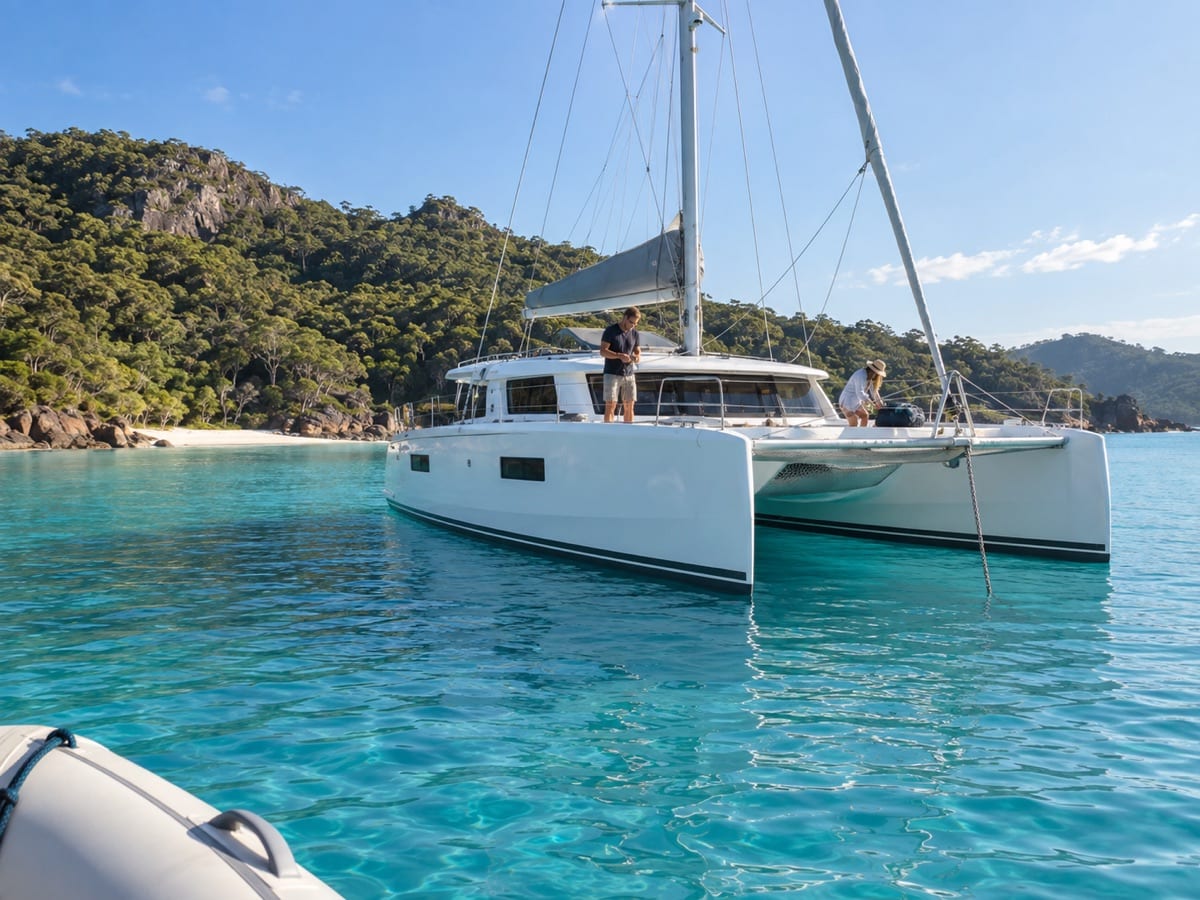
What this training covers
Anyone planning to own or charter a catamaran should seek multihull-specific training.
Differences include:
Australian providers currently advertising dedicated catamaran pathways include schools using RYA, IYT, ASA or bespoke training.
Course names and content vary between schools, and this is a description of the training rather than one school’s syllabus. Check what a particular course actually includes — and on which boat — before booking.
The course in context
Cruising-catamaran training addresses the practical differences of a wide, twin-hulled yacht, including handling, visibility, crew communication and systems. It is not the same as beach-catamaran lessons. Previous monohull experience is useful, but it does not remove the need for boat-specific familiarisation.
Before you start
Tell the school whether you are a beginner, an experienced monohull sailor or preparing for a particular charter. Some catamaran qualifications build on existing cruising certification, while other programmes combine the foundations with multihull training.
Skills you will develop
Powered handling
Understand the twin-engine boat’s response and the visibility available from the helm. Practise with instruction rather than assuming a monohull approach transfers unchanged.
Sailing and loading
Discuss sail management and the boat’s operating limits. A different motion and limited heel should not be mistaken for the absence of loads or risk.
Wide-beam routines
Coordinate berthing, anchoring and movement around the boat. Distances between crew positions can make communication more important than expected.
Training and assessment
Confirm the yacht size, engine arrangement and practical helm time. Ask whether the course awards a named catamaran certificate or provides familiarisation only, and verify any charter acceptance separately.
Questions to ask the school
- Which cruising qualification is required first?
- How much twin-engine handling will I practise?
- Is the boat comparable to my planned charter?
Related learning
Cruising & passages
Mile Building Courses
Mile building courses in Australia — converting course competence into logged sea miles, watchkeeping and real passage experience.
Passage-Making Courses
Passage-making courses in Australia — the full process from plan and preparation through watches and landfall to review.
Night Sailing Courses
Night sailing courses in Australia — lights, watchkeeping, judging distance in the dark and the skills every coastal passage eventually requires.
Offshore Sailing Courses
Offshore sailing courses in Australia — heavy weather, self-sufficiency, watch systems and the training that precedes a bluewater passage.
Where this sits in the schemes
Training like this is taught both as a named certificate within a scheme and as standalone tuition by independent schools. If you want a certificate at the end, start from the scheme; if you only want the skill, an afternoon with a good instructor may serve you better.
Is this the right training for you right now?
Three questions — have you sailed before, what boat do you want to sail, and what is your goal — give you a starting course and the schools that teach it near you.