
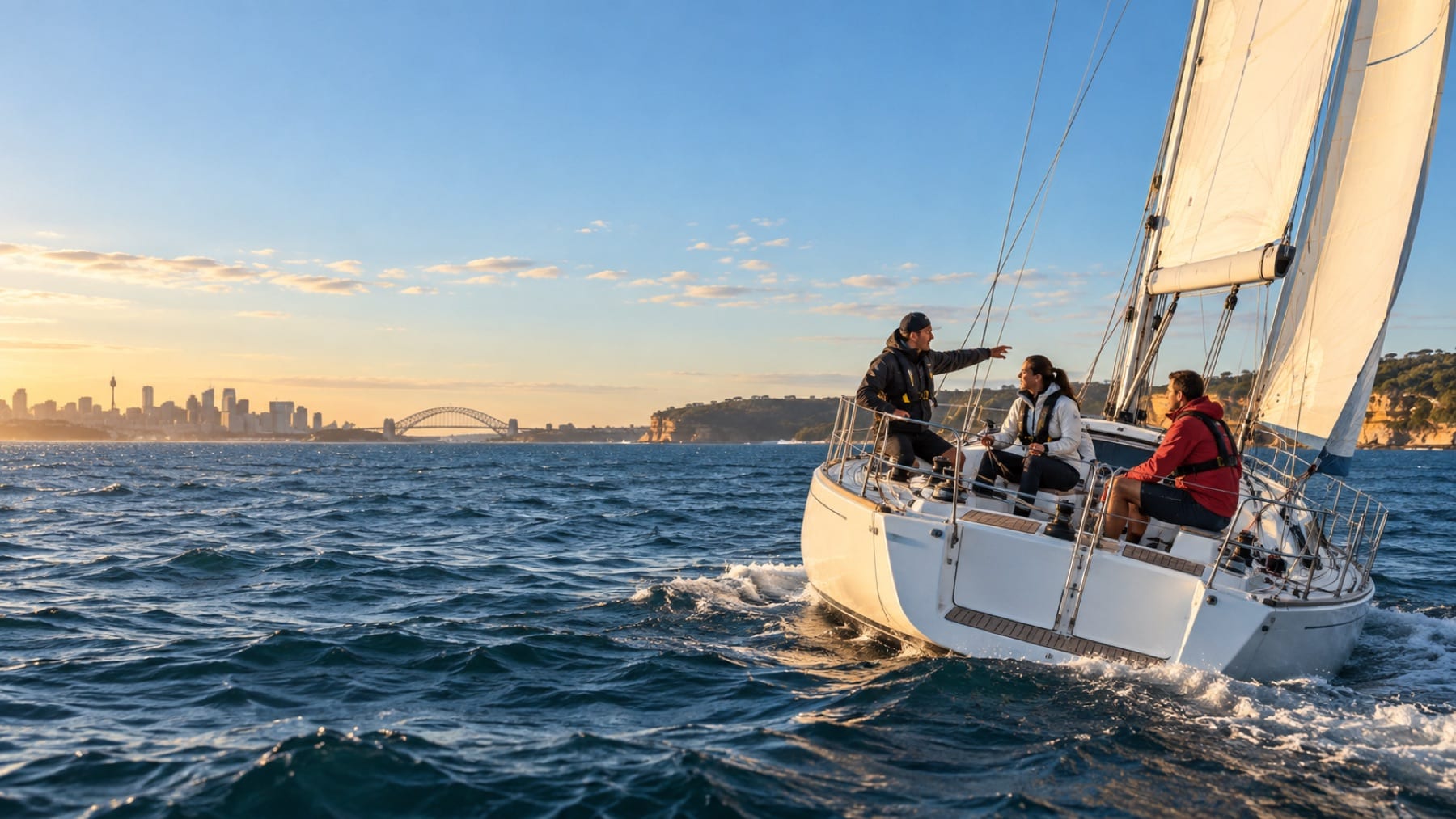
What this training covers
Couples planning to cruise together should train as a team.
Both partners should ideally learn:
The goal should not be to create one skipper and one passenger.
Course names and content vary between schools, and this is a description of the training rather than one school’s syllabus. Check what a particular course actually includes — and on which boat — before booking.
The course in context
Learning together can help a couple build shared skills and a common language aboard. It works best when both people receive genuine coaching and time in different roles, rather than one becoming the permanent skipper and the other being left to handle every rope.
Before you start
Tell the instructor about each person’s experience and confidence separately. Different starting points are normal. Discuss whether you prefer a private lesson, a small group or a liveaboard course, and what each person hopes to gain.
Skills you will develop
Role rotation
Both learners benefit from steering, sail handling and planning. Understanding the other person’s workload improves cooperation.
Clear communication
Practise short, timely instructions and confirmation without blame. A shared routine is particularly valuable when a manoeuvre becomes stressful.
Two-person organisation
Discuss how tasks change when there is no extra crew. Course exercises should fit the intended boat and remain within supervised training.
Training and assessment
“Couples sailing” describes how training is arranged, not a separate universal qualification. Confirm whether named certificates are offered and whether progress is assessed individually. One person’s completion should not be assumed to apply to both.
Questions to ask the school
- Will both of us rotate through all roles?
- Can you accommodate different experience levels?
- Are any certificates assessed individually?
Related learning
Learn to sail
Sailing Taster and Try Sailing Courses
Try sailing and taster courses — a few hours afloat with no commitment, and how to tell a real introductory lesson from a passenger experience.
Adult Sailing Courses
Adult sailing courses in Australia — learning to sail as an adult, on dinghies, keelboats or straight onto a cruising yacht.
Private Sailing Lessons
Private sailing lessons in Australia — one-to-one tuition at your own pace, on a school boat or your own yacht.
Where this sits in the schemes
Training like this is taught both as a named certificate within a scheme and as standalone tuition by independent schools. If you want a certificate at the end, start from the scheme; if you only want the skill, an afternoon with a good instructor may serve you better.
Is this the right training for you right now?
Three questions — have you sailed before, what boat do you want to sail, and what is your goal — give you a starting course and the schools that teach it near you.