- The goal
- Sail your own yacht confidently, including short-handed and in a crosswind berth.
- Assumes you have
- Ownership, and a range of sailing experience from none to plenty.
- How long, honestly
- Two to three days of own-boat tuition transforms most new owners. Confidence in a tight marina takes a season.
- What it is not
- Owning a boat is not a qualification. Insurers, marinas and crew all treat it as a separate question from what you can do.
Step by step
Book tuition on your own boat
An instructor aboard your vessel, in your berth, with your systems. Nothing else transfers as directly, and it is the single highest-value purchase a new owner makes.
Learn the engine
Most yacht call-outs are engine or fuel problems, not sailing problems. A diesel course pays for itself the first time you bleed a fuel system yourself.
Fix the licence question
A recreational boat licence is a state matter and has nothing to do with sailing certificates. Whether you need one depends on the engine and the state.
Get the radio certificate
Operating a marine VHF legally requires a certificate. In Australia that is usually the SROCP; the RYA SRC is a different certificate for a different jurisdiction.
Learn to sail her short-handed
Most owners sail as a couple or alone far more often than they expect. Short-handed technique is a separate skill from crewed sailing, not a reduced version of it.
Add navigation when you start going furtheroptional
Day Skipper Theory is worth doing even if you never sit a practical — it is where passage planning, tides and the rules actually get taught.
Almost every training pathway is written for someone deciding whether to get into sailing. New owners are in a different position: the decision is made, the money is spent, and the boat is sitting there.
Why own-boat tuition wins
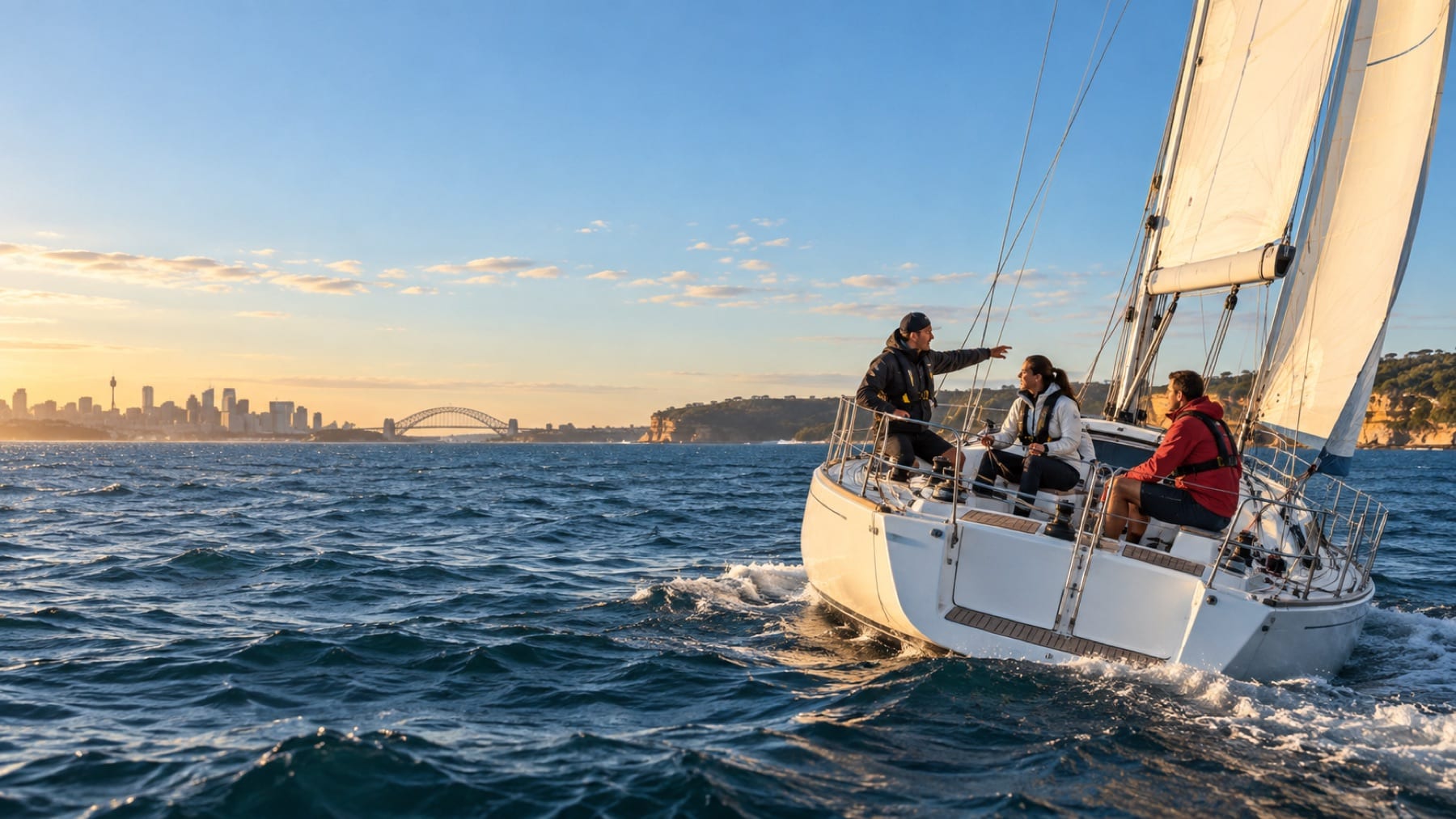
A five-day course on a school yacht teaches you to sail a school yacht. Useful — but your boat has a different rig, a different prop walk, a different windlass, an unfamiliar reefing system and a berth with its own peculiar set-up. An instructor aboard your own vessel addresses all of it at once, and does it in the conditions you will actually sail in.
It is also the format most likely to be booked in a shape that suits you — an afternoon, a weekend, or a delivery leg with an instructor aboard.
What new owners most often get wrong
- learning the sailing and ignoring the systems
- never practising a berth approach in a crosswind until it happens for real
- assuming a recreational boat licence covers the radio
- no reefing plan, so the first reef always goes in too late
- no man-overboard drill with the crew who actually sail aboard
Insurance
Some Australian insurers ask about qualifications and experience, particularly for larger vessels, offshore use or short-handed sailing. Requirements are set by the individual insurer rather than by a national rule, so ask yours directly — and ask before you buy the policy, not after a claim.
Every pathway
I want to charter a yacht
Hire a yacht without a skipper and sail it yourself.
I want to bareboat the Whitsundays
Charter a yacht or catamaran in the Whitsundays and sail it yourself.
We want to sail as a couple
Both of you able to sail the boat, including bringing her home without the other.
I want to sail offshore
Make ocean and extended coastal passages, as crew or as skipper.
I want to race
Race regularly at a club, as crew or on your own boat.
I want to teach sailing
Qualify to teach sailing at a club or a commercial school.
I want to work on boats
Be paid to operate or crew a vessel in Australia.
Not sure this is your pathway?
Three questions — your experience, the boat you want to sail, and your goal — give you a starting course and the schools that teach it near you.