
Home / RYA / RYA Dinghy Sailing Scheme
RYA Dinghy Sailing Scheme
The adult dinghy scheme in order: three levels, then modules you pick rather than climb.
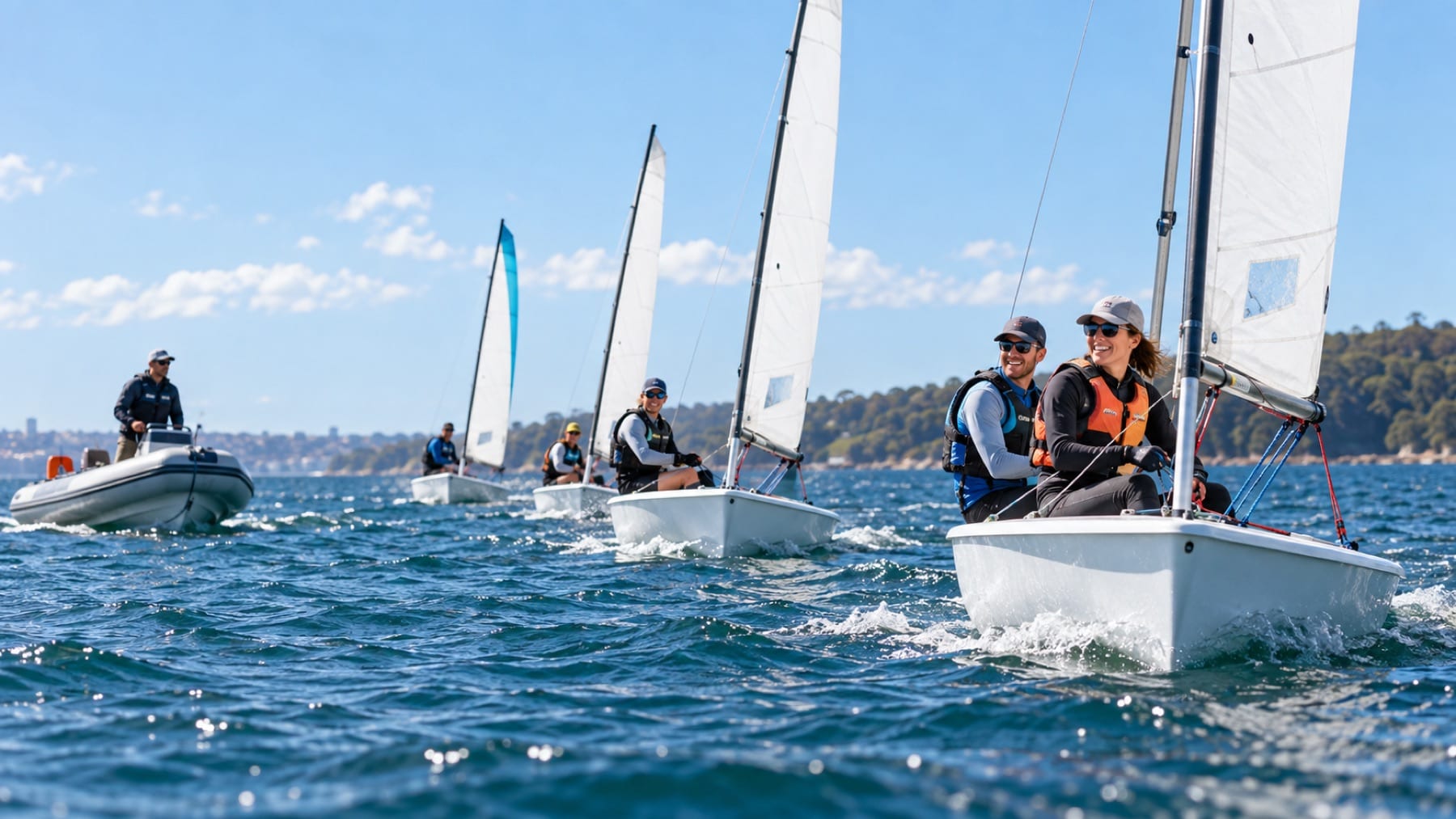
The RYA runs separate schemes for dinghies, keelboats, multihulls and cruising yachts. They share a teaching method and a certificate format, but they are not interchangeable, and a school that teaches one does not necessarily teach the others.
The three levels
The adult dinghy scheme is built as three progressive levels:
Then the modules
After Level 2 the scheme stops being a ladder. The advanced modules are chosen according to the sailing you actually want to do, in any order:
Sailors under 16 usually work through the Youth Sailing Scheme Stages 1 to 4 instead, which covers comparable ground at a pace built for younger sailors.
Australian availability is uneven. Dinghy instruction here is more often delivered through Australian Sailing clubs than through RYA centres, so check the scheme a school actually teaches before booking.
- Who it suits
- Anyone learning in a small boat, and anyone deciding between dinghy and keelboat training.
- What it is not
- It is not the cruising pathway. A dinghy level will not get you aboard a yacht as qualified crew.
Primary source: RYA training. Course structures and prerequisites can change; confirm the current version with the training body and school.
The course in context
Dinghy sailing makes the relationship between wind, steering, sail trim and balance immediately visible. The RYA scheme offers adult introductory levels, a separate youth pathway and further modules for sailors developing particular skills. It is not necessary to take every advanced module: choose one that fits the boat and sailing you want to do.
Before you start
Beginners start with introductory training; experienced sailors should describe their actual skills to the centre. Age, confidence around water and the ability to move within a small boat help determine the most suitable group and equipment.
Skills you will develop
Foundations
Learn to launch, steer, handle sails and return under supervision. Small improvements in control matter more than learning a long list of nautical terms.
Independence
Progress towards sailing in suitable conditions without needing a prompt for every turn. Independence still operates within the sailing area, weather limits and support arrangements.
Specialist development
Later modules address seamanship, day sailing, spinnakers, performance and racing. These develop different abilities rather than forming one compulsory ladder.
Training and assessment
Centres use different dinghies and session patterns. Ask about single-handed versus crewed boats, shore briefings, rescue cover and how progress is recorded. A sheltered-water course does not establish competence in every venue or wind strength.
Questions to ask the school
- Which boat and group suit me?
- How is capsize practice supported?
- Can I join supervised practice afterwards?
Related learning
Other RYA courses
RYA Sailing Pathway
The whole RYA cruising route in order, and where you are allowed to skip a step.
RYA Cruising Level 1: Start Sailing
A short introduction aboard a small cruising yacht — the shortest way to find out whether yachting suits you.
RYA Cruising Level 2: Basic Skills
The follow-on from Level 1, adding real boat handling on a small cruising yacht.
RYA Start Yachting
Two days aboard a cruising yacht, for complete beginners who want a genuine taste of yachting.
RYA Day Skipper Theory
The classroom half of Day Skipper: charts, tides, buoyage, collision regulations and passage planning.
RYA Day Skipper Practical Sailing
Five days in which you stop being crew and start being the person responsible for the boat.
RYA Coastal Skipper Practical
Skippering beyond familiar water and beyond daylight — longer passages, night pilotage, heavier weather.
RYA Coastal Skipper and Yachtmaster Offshore Theory
The advanced shorebased course: tidal work, passage planning, meteorology and collision regulations at Yachtmaster depth.
Australian schools using RYA
These schools advertise training under the RYA system. This does not confirm that every school currently runs RYA Dinghy Sailing Scheme; check the current course list directly.
Which course should you actually book?
Three questions — your experience, the boat you want to sail, and your goal — give you a starting course and the schools that teach it near you.