
Home / RYA / RYA Sailing with Spinnakers
RYA Sailing with Spinnakers
Hoist, gybe and drop without wrapping the kite around the forestay.
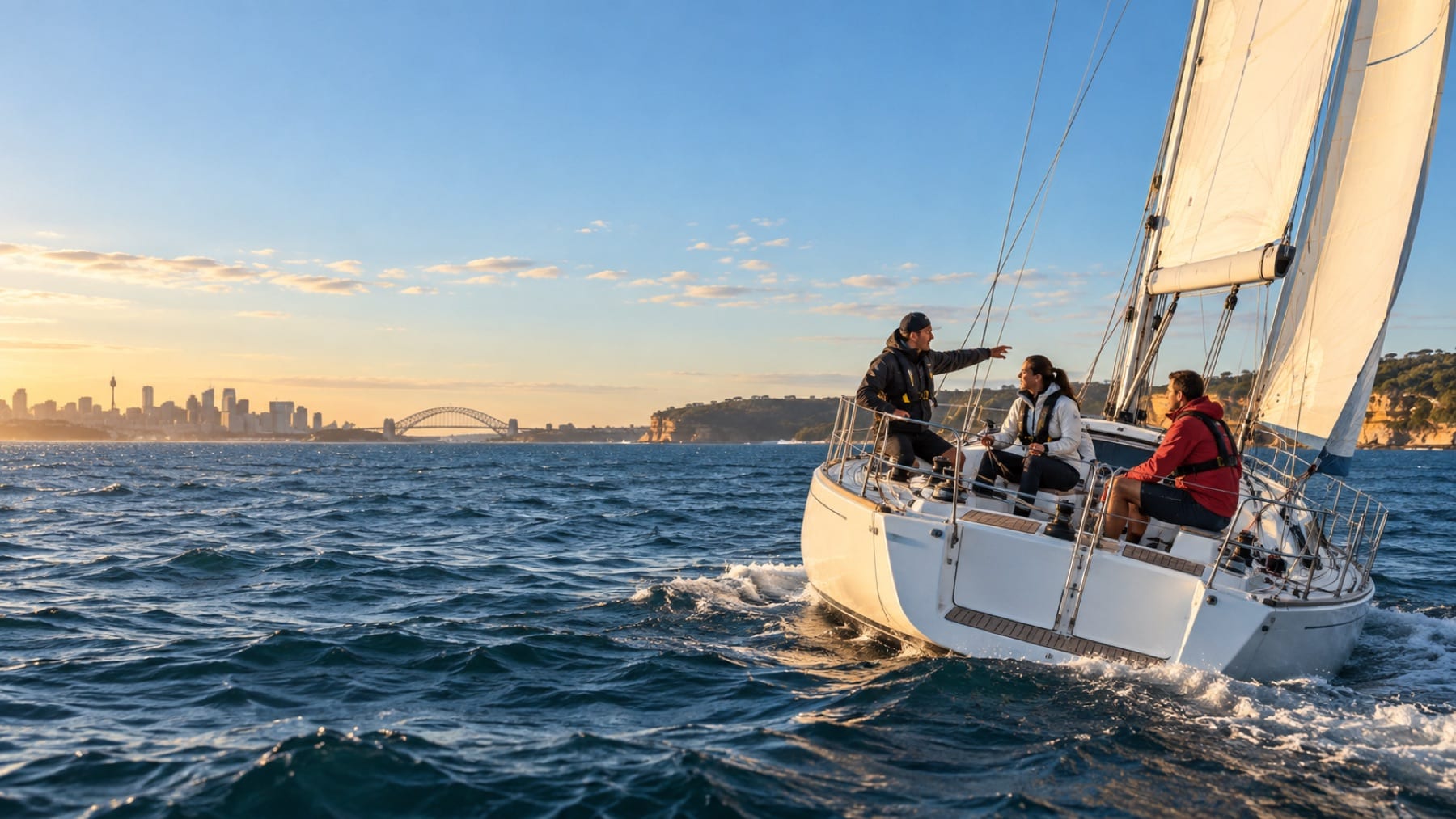
Sailing with Spinnakers is the advanced dinghy module for downwind sail handling, covering both symmetric spinnakers on a pole and asymmetrics on a bowsprit.
Typical content:
Most club racing in Australia happens in boats with an asymmetric. If your reason for taking the module is joining a fleet, ask which sail the school teaches on — the two are handled very differently.
- Who it suits
- Level 2 or 3 sailors moving to a boat with a kite, and crews joining a club racing fleet.
- What it is not
- Not a racing course. It teaches handling, not tactics.
Primary source: RYA training. Course structures and prerequisites can change; confirm the current version with the training body and school.
The course in context
This module adds a more powerful downwind sail to dinghy sailing. The challenge is coordinating preparation, boat balance, steering and several lines at the same time. It is useful for sailors moving into a spinnaker-equipped boat, whether their interest is racing or enjoyable recreational sailing.
Before you start
You should be comfortable with the dinghy’s ordinary sailing controls before adding a spinnaker. Ask whether the course uses a symmetric or asymmetric sail, because the equipment and crew routines differ.
Skills you will develop
Preparation and roles
Understand what each line and crew position contributes before the sail is raised. Good organisation reduces the need to solve a tangle while the boat is already accelerating.
Hoists and recoveries
Learn coordinated transitions under instruction. A successful launch includes being ready to recover the sail, not merely getting it flying once.
Trim and balance
Connect steering, sail shape and crew movement while sailing downwind. Controlled progress is more valuable than chasing speed before the routine is reliable.
Training and assessment
Training is practical and weather-dependent. Confirm the boat, sail type and student-to-instructor arrangement. Experience on one system may need adapting before you use a different dinghy or a cruising yacht’s setup.
Questions to ask the school
- Which type of spinnaker is taught?
- Will I practise both helm and crew roles?
- What ordinary sailing skills must already be secure?
Related learning
Other RYA courses
RYA Sailing Pathway
The whole RYA cruising route in order, and where you are allowed to skip a step.
RYA Cruising Level 1: Start Sailing
A short introduction aboard a small cruising yacht — the shortest way to find out whether yachting suits you.
RYA Cruising Level 2: Basic Skills
The follow-on from Level 1, adding real boat handling on a small cruising yacht.
RYA Start Yachting
Two days aboard a cruising yacht, for complete beginners who want a genuine taste of yachting.
RYA Day Skipper Theory
The classroom half of Day Skipper: charts, tides, buoyage, collision regulations and passage planning.
RYA Day Skipper Practical Sailing
Five days in which you stop being crew and start being the person responsible for the boat.
RYA Coastal Skipper Practical
Skippering beyond familiar water and beyond daylight — longer passages, night pilotage, heavier weather.
RYA Coastal Skipper and Yachtmaster Offshore Theory
The advanced shorebased course: tidal work, passage planning, meteorology and collision regulations at Yachtmaster depth.
Australian schools using RYA
These schools advertise training under the RYA system. This does not confirm that every school currently runs RYA Sailing with Spinnakers; check the current course list directly.
Which course should you actually book?
Three questions — your experience, the boat you want to sail, and your goal — give you a starting course and the schools that teach it near you.